
KhmerConnection
KhmerConnection is a community-maintained guide to Khmer community life and cultural memory. It connects people with organizations, creative works, living traditions, heritage and first-person stories.
Our culture. Our communities. Our stories.
History
KhmerConnection was founded in 1999 by Vibol Hou and Poli Bou as one of the first online homes for the Cambodian world: a single destination where a diaspora scattered by war and resettlement, and a Cambodian public just coming online, could find each other. It operated from Long Beach, California, the largest Cambodian community outside Cambodia.
At the time, Cambodian websites existed, but they existed alone. There was no shared communication layer, no common place where news, opinion, and people met. The founders believed the internet could do more than publish; it could empower. KhmerConnection was built on a simple premise: give Cambodians the tools to inform, express, and imagine, and the community would organize itself.
KhmerConnection offered Cambodian news, articles, and community resources, discussion forums, free personal homepages and member profiles, instant messaging and free email long before social media came about.
Membership grew to more than 10,000 registered people, and for roughly five years KhmerConnection was the most visited Cambodian website in the world. It became the default gathering point for Khmer youth, students, artists, activists, and families across the United States, France, Australia, and Cambodia itself. For many Cambodian Americans of that generation, KhmerConnection was their first experience of being Khmer online.
The portal era ended, as it did everywhere, when social networks, mobile phones, and messaging apps absorbed what portals used to do. Its significance was never the brand. It was the proof: that a small, self-funded, community-run platform could give a dispersed people a shared venue for culture, news, and connection, and that Cambodians would build there if someone opened the door. Every Khmer Facebook group, Telegram channel, and diaspora network that followed inherited that pattern.
- KhmerConnection at Long Beach Cambodian New Year
-
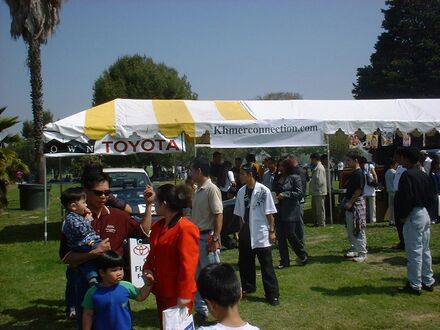 KhmerConnection launch booth, April 2000
 -
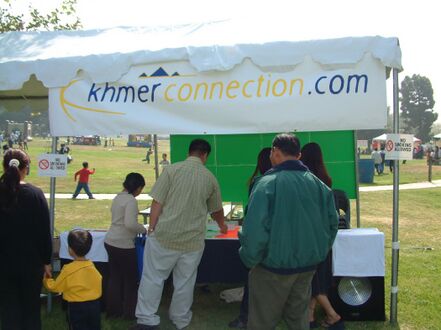 KhmerConnection v2 launch booth, April 2002


Forward
KhmerConnection returns 26 years later for the same reason it began: the pieces exist, but a connective layer is needed. Khmer-serving organizations are spread across continents, generations, and languages, and no one has kept a shared, current, openly editable record of who they are and what they do. The portal gave the community a place to talk. This wiki gives it a place to be catalogued, found, and carried forward.
KhmerConnection brings together the organizations, works, practices, places and stories that connect Khmer communities. Readers can find community associations, temples, cultural businesses, scholarships and other opportunities, alongside books and films, living traditions and music, dishes and the recipes that carry them, heritage places and cultural objects held in museums abroad, resources for learning Khmer, an index of oral-history recordings held by archives and universities and the creators behind them.
Anyone can read the wiki. Contributors help document community knowledge, preserve historical context, add sources and keep information useful.